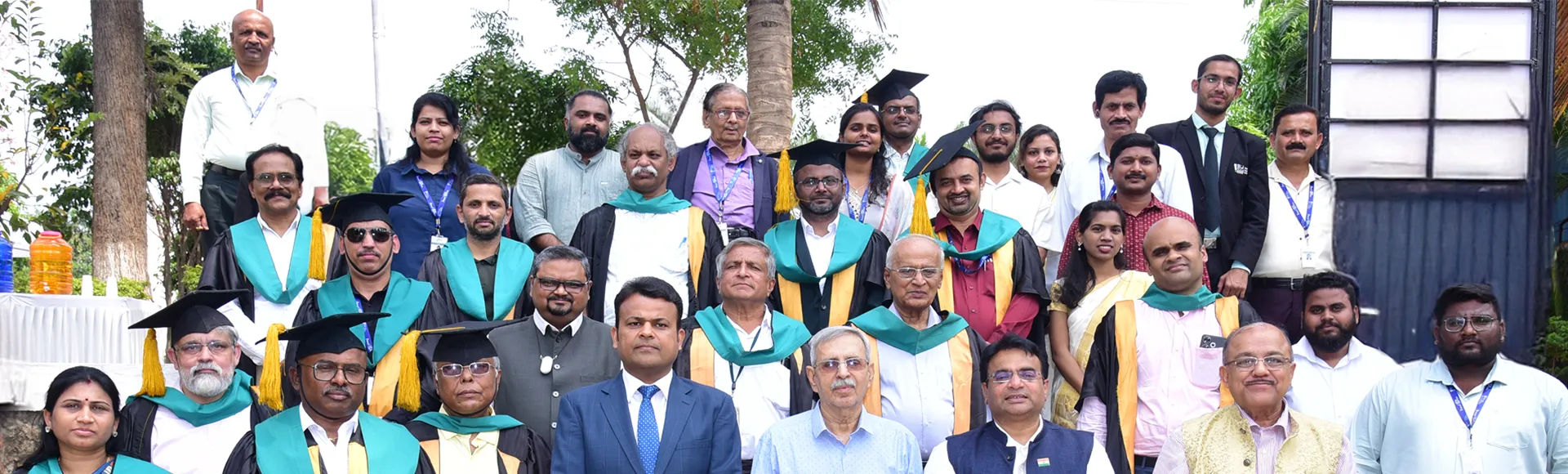
Experiential learning methods designed and used by IBA faculty in the PGDM programme.
01
STEM Based Simulation
AVeRA Aviation Hub – A STEM Based Simulation Game with Hands-on Activity
Course
PGDM
Batch
PGDM 2026-28 – Orientation (July 2026)
Offered Under
Wh(Y) Series, a programme which orients students towards thinking, asking questions and probing which are essentials for research and professional excellence
Duration of the Simulation
3 hours
Ideation and Execution
Dr. A.V Ramana Acharyulu, Professor, IBA Bangalore
Introduction
As part of the Orientation Program for the newly inducted PGDM Batch of 2026-28, an attempt was made to offer a hands-on experience of learning how a specific sector and sub-sector within an industry operate, in a dynamically evolving startup ecosystem. The popularization of Science, Technology, Engineering and Mathematics (STEM) based learning during the last few years offered an opportunity to build inter-relations within various elements of management education and construct an experiential learning module as part of orientation to the post graduate program in management. The need was felt acutely as a large proportion of students coming from social sciences background and immersing them with physical and natural sciences and engineering and technology students so as to build integrative learning teams for the coming two years of their studies at IBA further stressed the importance of developing and conducting such a game.
This game was conducted in three separate tranches for different sections of the batch, to offer every individual student an equal and immersive opportunity to play across one of the various roles in an industry and appreciate firsthand the dynamics involved in running a business in such an ecosystem.
Objectives
The Game was built to meet multiple objectives, simultaneously and in an integrative manner, touching upon, spotting strategic opportunities, choosing a manufacturing strategy, building supplier networks, developing relations with banking and financing partners, and learn emerging customer needs and match them with the product offers. These are spelt as below:
To introduce students how near real-life dynamics shape the evolution and success of businesses related to an industry
To recreate the entire ecosystem that exists in avionics industry
To emulate and involve various players to understand and learn by participating in supply chain activities and procurement and sourcing of critical and ancillary components for setting up a manufacturing startup
To introduce the elements of competitive strategy and take clear decisions either to pursue a cost leadership strategy or a differentiation strategy while choosing the design, process and suppliers for the manufacturing and marketing startup
To build a supportive ecosystem of banking, marketing and TQM players that strive to prosper with the success of the manufacturing firms
To introduce the elements of an emerging subsector within an existing industry and build a marketplace where consumers thrive with the complimentary support of other industries that add to the business elements and introduce services related to TQM and Advertising and sponsorships
The Flow of the Game
In this game few teams of students set up and run a start-up, each of them attempting to build passenger airplanes and sell them to potential customers. The learning ecosystem is created at three layers and each of these created and operated with the help of game instructor inside the class-room.
The first layer of the game addresses the student teams becoming a part of an existing aviation enterprises ecosystem where they scout for and obtain designs, patents and licenses to build aircrafts. Their ability to steer through the vendors source the technologies and build a supply chain becomes the first layer.
The second layer is focused on internal operations, where actual manufacturing of the airplanes happens and bringing out a functional, operational aircraft in real time.
The third layer is focused on the external world, where finding potential buyers and marketing their airplanes and eventually sell them using the help of third-party marketing services providers. The game is wrapped up by identifying the teams that have successfully manoeuvre their balance sheets and report profits from their operations. The top two or three teams with highest profit are acknowledged.
Resources
Kits of TWO Different designs and models of aircraft whose patents are available for franchise
Kits of OEM components of aircraft to be built
Kits of ancillary components for building an aircraft (which are usable by both the designs but with different capacity offer for the airplanes)
Kits of quality control tools
Kits of advertising and branding materials/ Sponsorship Kits
Game Currencies – regular and/or crypto and banking instruments
Accounting record keeping kits
Performance metrics record with instructor(s)
Timelines
The game is structured to run for around 145 minutes and another 15-20 minutes were allocated for debriefing and feedback from the class.
Results
The game was played for three sections each comprising 50 students each, where 48 students were assigned various roles and two students were to support game instructor. However, as there were absentees in each class, all students present were offered roles to play the game and bring results.
In each section, four startup manufacturing startups were the central characters, whose task is to set up their enterprise, raise finances, obtain licenses and procure components and parts manufacture at least one fully functional and operational airplane and find customers, get the planes tested, certified, and sold. Of the four startups, a maximum of two firms get a chance to get sponsorship from two top companies which offer advertising revenues besides the sales proceeds.
At the end of the game, the following results were recorded.
In one section, of the four startups, one startup got disqualified and had to close its business; and two firms got their planes made and demonstrate them fully functional. One startup had glitches in making the plane pass all TQM tests, including plane running in reverse instead of forward, which with grace period, could rectify and sell its product as well.
In another section, three startups failed, including one firm which broke the plane parts and failed to assemble, two others assemble but couldn’t complete all steps in assembly and fail to present a functional plane and only company successfully assemble, operate, pass TQM tests, and sell to the customers and secure sponsorship.
In the third section, all four startups were in a position to procure correct parts, assemble as per the process diagram, get them tested to meet TQM standards and sell to customers. They were even rewarded with four sponsorships, making them financially also successful.
Unexpected Outcomes
The game led to an important rediscovery and assurance of how a scientifically designed and developed game can ensure unbiased, eager and open learning pursuits by students. The game was played with different sections/ classes on different days, to make sure that requisite ambience, facilities and support mechanisms are provided to each class. In such a scenario, where one section plays the game first and subsequent classes play them later, the risk of students undermining the game or its elements exist, in a typical class room based experiential learning models – the element of routinization of an experience and making it too obvious to lose the learning process. It was noted by the instructor that despite various ways of communication across all students, either through social media or in face-to-face interactions, students of one section couldn’t influence other sections and as such each class participated without any bias and/or preconceived notions of what clicks or not and how they could reduce the process to a routine rigmarole in a class room. The game design ensured that a scientifically built randomization process for each student and each role of the game made sure that the surprise element continued the enthusiastic involvement and participation of all students in each classroom.
Supplementary Outcomes
Firms that were in aviation banking had to showcase their ability to offer loan products and function as bankers and gain their share of economic benefits.
Firms that were in design and patent sales had difficult time to differentiate themselves and get their customers convinced to pick their designs; and their joint venture partners who supply OEM components and ancillary components had to face consequent dynamics of either higher or lower demand than their stocks. A different scenario was faced by ancillary components and fuel solutions services providers, where spikes of demand for high power solutions and long range power supply solutions was witnessed in two sections while in one section, startups chose to be conservative and go for affordable energy solutions, driving their demand to peak levels.
All suppliers found their equilibrium by being able to dispose of their stocks after very intense negotiations and making their finances as well into black.
Conclusion
The game provided an opportunity to every student to get an opportunity to perform the roles of either supply chain or marketing and have a hands-on opportunity to build a functional product on their own. Learning concepts of production and operations management. Learning the significance of design and process flow; ability to conceptualize what they could offer to potential customers and as such create a brand in their own way and impress the sponsors of their product being superior. It further showcased the ability of students to deploy their nascent negotiation and bargaining skills on one side, dexterity of making a real-time airplane using the given tools and materials and sense the pride of making a product in real-time were all observed and witnessed in every classroom.
02
Economics Simulation
Competitive Strategy Game
Course
Micro Economics
Program
PGDM
Trimester
I
Faculty
Dr Mansi Bansal / Prof. Prashant Kulkarni
Pedagogical Tool
Simulation
Introduction
Competitive Strategy Game was developed at University of California Berkeley. Indus Business Academy (IBA) is the only Indian institution to use this simulation game. The list of schools using the game is available at https://faculty.haas.berkeley.edu/borenste/csglist.html.
This was introduced for the Batch 2012-14 and since then has been used continuously. More than 35 games have been played since its introduction and has been the most popular event in the Economics course calendar.
Objectives
The objectives of having Simulation as part of Economics Course can be summarized as follows:
Economics is often viewed as a subject underpinned in abstracts. There are numbers and graphs and equations and the common perception is about them being carrying little links with practicalities of real life. This has to be changed
Concepts are text bookish and despite lot of efforts difficult to bring about an understanding how these find value in real life. Therefore, a flair on how economics works in real life needs to be understood
The competition is never static. There are entries and exits. Each entry and exit have their own costs and benefits. To those staying the markets, it is essential they learn to plan for these. A simulation is thus critical in enabling the students grasp this point with its own costs and benefits
Market structures are not static. They are dynamic. It is all about how markets play out and affect the fortunes of incumbents and the entrants alike that is the essence of simulation
There are costs in production and firms have to plan for the same. The production is linked to the competition and the criticalities of these linkages are best understood through simulation
It is a question of supply and how much do you supply. Theory cannot explain completely and thus a practical understanding is desirable. Thus simulation
Understanding demand patterns is a must and of course appears obvious. A first-hand experience of the same is best ingrained through the participants through simulation where they get hands on experience.
Every market has its characteristics and the ever pertinent question in economics on what to produce, how to produce and for whom to produce find an answer through gamification which is this simulation
Thus towards a practical understanding of economics and business, simulation was introduced
Detailed Modus Operandi
The competitive strategy game is a simulation of the competitive interaction between eight companies that compete with one another in one or more of four different markets. The markets differ in size, market elasticity of demand, degree of product differentiation, ability to store the product, capital intensity of production, and the degree to which investments are sunk. In a given market, the companies have different costs of production — entry costs, capital costs, and marginal costs. One firm may be the most efficient manufacturer in market A, but may face the highest costs of entering market B. One market may be hospitable to many of the companies at once, while another may offer a profitable opportunity to no more than one incumbent.
Each company is controlled by a team of students who decide which markets to enter, how much capacity to build, when to reduce capacity or exit a market, what quantities to produce and what prices to charge. In each period, each company submits a strategy specifying these variables. The markets then operate for the period. At the end of each period, every team receives a market update — which has public information on prices, capacities, and approximate market sales — and a company update — which has the relevant income statement and balance sheet information, such as capacity, production, sales, inventory, capacity costs, variable costs, interest paid or earned on cash balances, and cash position.
An important aspect of the Competitive Strategy Game is the role of information. Some data are public information, such as all firms' prices and production capacities, the degree of substitutability across brands within each market, and some basic information about demand. Other variables are known only with some noise. For instance, each firm knows its own sales in each market, but the total sales in each market is known publicly only with a degree of error. Similarly, no firm knows the production costs of its competitors with certainty, but it does know the distribution from which costs are drawn.
Each firm begins with a cash reserve and makes strategic decisions in an attempt to maximize the value of the firm. The game will run for nine periods. In each period, the companies make decisions on how much to offer goods for sale, the price at which they are offering the goods for sale, decisions whether to increase or reduce capacity, decisions whether to enter a new market or exit an existing market.
The faculty will release the rankings at the end of each period to enable companies know where they stand. The faculty will also give his comments on the game so far and what might be expected in the future. The winner will be the company that has the highest cash in hand at the end of period 9.
Process of Simulation
It’s played over nine periods. Each group represents a company. The game is designed to have eight companies. Each student group comprises 6-7 students. Since the number of students are usually high, this means that multiple games are played.
The students choose a 3 letter word as the name of their company. They are briefed in detail and given certain information on the game. The students get the information about the demand characteristics of each of the four markets like population, population growth rate, mean reservation price and its standard deviation. They are also given the data on costs. They know the entry costs of the market, costs of building a capacity per unit, marginal cost of production for their firm in each of the markets. They are also given the mean and standard deviation of each of these costs so that they have an idea what costs might be existing for their competitors.
Each period, teams are required to enter the price they are willing to sell at, the production quantity, and details of capacity increase or decrease in the market. Once they fill before the deadline, the game is locked and faculty plays the game through the software. The results are shared with the students. Each team will know its position in terms of quantity sold, inventory left over, the costs incurred for production and for capacity creation or deletion and the final cash in hand that is there with them at the end of the said period. They also know the capacities at the end of the period for each firm in each market as also the prices set by the other firms in the period that ended. They also get an approximate sales figure so they figure out possible sales by each firm, possible inventory, possible price the firm can set in the next period etc.
This process is repeated for nine periods as actions and reactions and counter-reactions. As indicated, the faculty will keep posting comments after each period so that the teams get an idea where they stand and what might be their future prospects.
Concepts Taught through Simulation
Investment decisions
Demand functions
Supply and production function
Pricing under information asymmetry
Costs of production – fixed and variable costs, marginal costs, sunk costs
Market structures and how the market structures change
Signalling and decision making under information asymmetry
Barriers to entry
First mover advantage and late mover advantage
Basics of game theory
Links between statistics and economics
Link to Course Objectives
Figure out the journey towards analysis and application of economics in the environment of management practice.
Market structure, production and cost functions
Determine analytical tools to understand how individuals and societies deal with the fundamental problem in a universe of scarce resources.
Tools for pricing under information asymmetry, market entry and exit decisions under information asymmetry
Formulate economics approach to everyday decisions faced by individuals as they try to maximize their utility, to businesses that try to maximize profits and to the whole of society as it attempts to use its resources efficiently.
Economics thinking in coming out as a winner in a business. Highest cash-in-hand at the end of simulation will determine the winner.
Impact and Outcome
The simulation carries twenty marks in the overall scheme of evaluation.
In line with the accreditation standards set by NBA, we derive an attainment matrix which captures the attainment of course objectives and the subsequent linkages with the program objectives.
We find that on an average 89% of the students have attained the said objectives on an average over the last five years.
This is in contrast to lower attainment which happens in the evaluation done through midterm and end term assessments.
To cite an example, in AY2021-22, Attainment for End term and Midterm together was 78%, the Simulation recorded 88%, the composite of internal assessment (Simulation + other assessments like quizzes, assignments etc.) came to 81%.
Similarly, for the AY 2022-23, we find similar figures. Attainment for End term and Midterm together was at 76% while Simulation recorded 87%. When we take the combined internal assessment (Simulation + quizzes and other assignments), the number drops to 79%.
Likewise, for the AY 2023-24, we find similar figures. Attainment for End term and Midterm together was at 75% while Simulation recorded 88%. When we take the combined internal assessment (Simulation + quizzes and other assignments), the number drops to 79%.
This also buttresses the point that using tools like Simulation are likely to increase learning outcomes relative to conventional assignments.
03
Run-Me-Out Contest
Course
B2B Marketing
Course Instructor
Prof. Nagendra Hegde
Administered to
5th trimester students
Introduction
The phrase “Run-Me-Out” denotes the meaning “to challenge someone” or “to question someone/something” or “to explore something”. As the name indicates, the contest strives to get the students “challenge the concept or to not to accept the fact the way it is”. The activities put their brain to test by letting them think in a reverse order (thinking other way round).
Objectives of the Contest
To understand the degree of prior-knowledge the students have on B2B markets.
To familiarize the students on the fundamentals of B2B market and marketing in B2B space.
To foster students’ exploring capabilities on fundamentals of B2B Marketing and facilitate more deliberations.
To trigger the learning abilities of students by setting up competitive environment through learning games.
To make students conceptually strong by encouraging them to think from different perspective and to enable them to critically examine ideas and facts.
The Activities
The students take an online quiz on B2B marketing – This helps the instructor to meet the first objective stated above. Time given – 10 minutes
Two articles on fundamental concepts of B2B market are prescribed for students to study. Students are circulated with a case on B2B as well for a deeper understanding of the practical application of concepts. The students are asked to create a question bank based on the articles/cases provided. They can create as much questions as possible. In the end, they have to shortlist five best questions out of the listed questions (the best questions of their choice).
Students are then asked to write answers for the shortlisted five questions.
Questions along with the answers have to be submitted to the instructor in the word file.
Top 10 students would be selected based on the questions and the answers. Then, these students would be mixed to form two teams of 5 members each to challenge each other on the subject. They would be lent a helping hand in preparing for the discussions. The final top 5 would be selected based on the audience poll. Audience would select those top 5 students who they think have given them best inputs on B2B basics.
Those top 5 students would face the instructor head-on and they challenge him during the deliberations. The subject would be dealt in depth during this final deliberations. These top 5 students are called as “B2B Stars” and they would be given full 10 marks from this contest. And they would get a direct entry into the next contest.
This would be a unique and different experience for them as well. Students find it challenging to frame questions.
Session 1
Students take quiz – 10 minutes
Students are given an article link (B2B Market place to accelerate in India) to go through – 10 minutes
The article “New B2B Imperative” is circulated for their reading reference – 45 minutes
A case on “Reliance Infocomm” is circulated for their reading and reference – 60 minutes
Evaluation Parameters of Questions and Answers
Questions (Overall weightage – 70%)
Weightage in %
Answers (Overall weightage – 30%)
Weightage in %
Specificity of the question
15%
Coverage
40%
Degree of relevancy
15%
Critical thinking ability
40%
Creative/out of the box question
20%
Relevance
20%
Amount of study it demands
50%
Session 2
Top 10 students would have deliberations on the subject. They would be assisted by the course instructor beforehand.
Top 5 students would then challenge the course instructor and try to run him out.
04
Candle Light Experiment
Candle Light Experiment for Inner Invocation
Course
Management Perspectives
Course Instructor
Dr. Subhash Sharma
Administered to
1st trimester students
Introduction
Candle Light Experiment is an experiential approach for expressing one’s creative potential as well as to learn some management, leadership, creativity and spirituality lessons from the candle light. The idea of candle light experiment for inner invocation owes its origin to the instructor’s blackout experience in 1997 arising from a power outage.
Candle light creates its impact in darkness. The basic purpose of this experiment is to elicit creative thinking among students which leads to inner invocation, thereby realization of one’s own creative potential.
This experiment is tested in several premier B-Schools including IIMs, Management Development Institute (MDI) and others. It is tested in Management Development Programs, Faculty Development Programs and in other corporate training programs since 1997.
This experiment is regularly conducted on 1st trimester students since many years and is well accepted by all.
Publications
This was first published in 1999 and then in 2007, 2010 and 2012. The mention of this experiment is available in the books Quantum Rope: Science, Mysticism & Management (1999, Chapter – Light of Wisdom, pp127-132), New Mantras in Corporate Corridors: From Ancient Roots to Global Routes (2007, pp. 466-471) and in Shunya Poems: My Experiment with Corporate Rhymes (2010, p 10), all written by Dr. Subhash Sharma. It is also published in 3D IBA Journal of Management and Leadership.
Experiment Method
The class is divided into small groups of six to seven members. They sit in a circle arrangement.
Each group is provided with a candle and the candle is placed right in the center of the circle. They light the candle and observe it for two to three minutes.
Group members individually write observations, feelings and emotions that flow through their mind while observing.
A group leader is selected and group members read out what they have written and share their observations. Unique observations emerging from the group are noted down. On the basis of the group discussions, groups give a name to their team.
Depending upon the availability of the time and the size of the class, two to three members in a group are given a chance to read out their observations. Group leader, then presents the summary, names a group based on that and explains how the name suits his group. Other groups may also ask questions while the presentation is on. The course instructor highlights the important points emerging out of the discussions and provides additional insights to observations of the group.
The course instructor sums up the observations of all groups by linking the group observations to various management theories, philosophies, leadership, creativity and spirituality concepts that students may have learnt in classes.
Sample Responses from the Participants
“Candle shows us three S – Sincerity, Service and Sacrifice and two Ds – Dedication and Devotion. I felt a sense of warmth, and feel that while giving light it sacrifices itself and felt some enlightenment in my mind.”
“A single candle spreading happiness and hope for a new beginning. A candle symbolises hope. When all paths are closed, a single streak of light may spread positive energy.”
“When wind is blowing, candle light is struggling to become stable. In our life, we also face lot of problems, but we have to fight with our problems and find creative solutions.”
“Flickering of flame symbolises struggle in human life. Candle shows us path by giving light.”
“I saw the aura around the flame and it reminded me that every human being has an aura, but, we can’t see it. An abstract question came to my mind, why I can’t see the aura of human being?”
Experiment Leading to Management Theory
The experiment leads to a theory of leadership, theory of Human Quality Development (HQD), Theory of Creativity, Theory of Consciousness, Theory of HOPE (Higher Order Purpose of Existence) to name a few.
This innovation in teaching is well accepted by all as it promotes an empowered thinking.